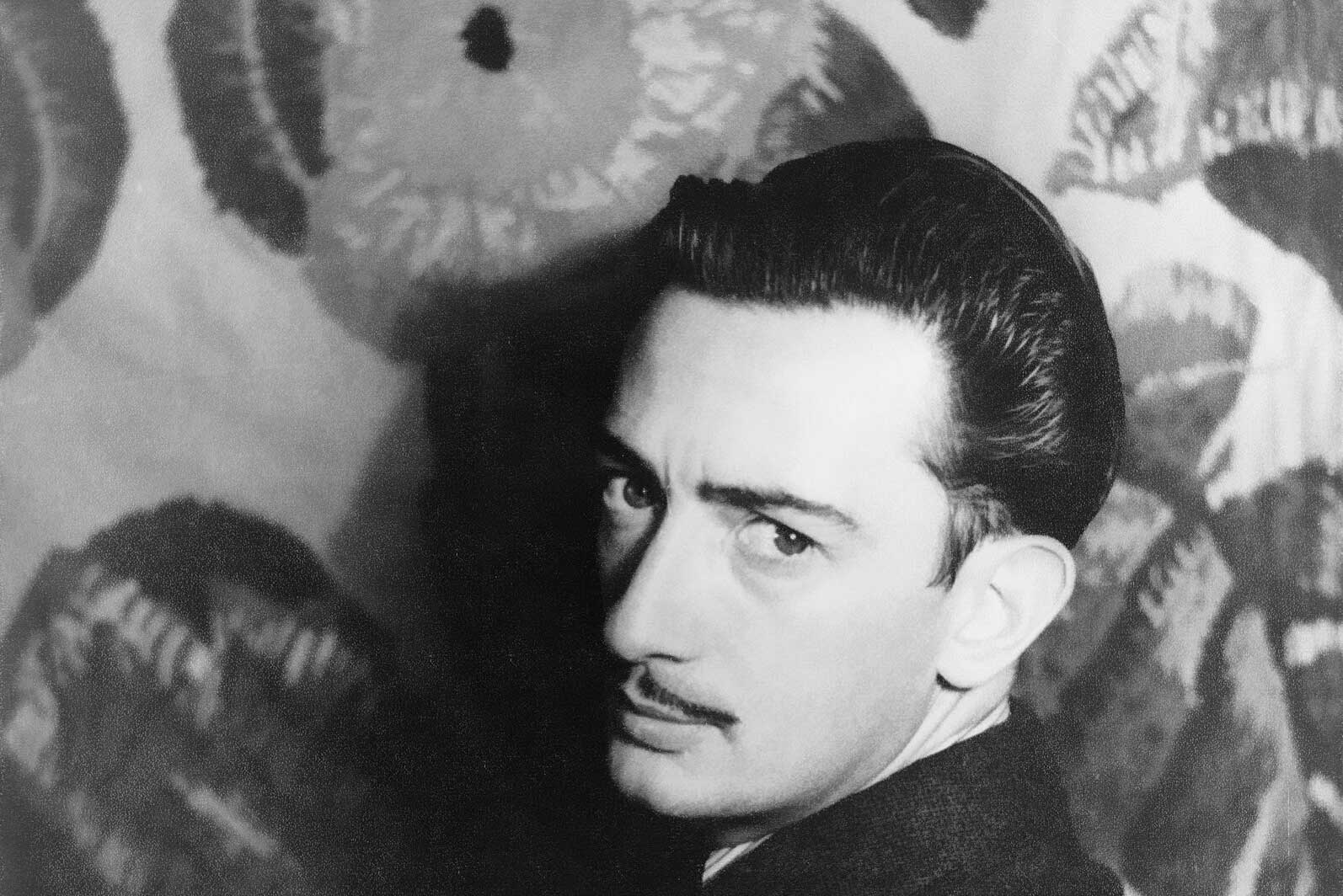
Salvador Dalí, the enigmatic Spanish artist born in Figueres in 1904, blurred the lines between genius and eccentricity like few others in history. As a cornerstone of the Surrealist movement, his melting clocks, distorted landscapes, and dreamlike imagery turned him into a household name. At the same time, his flamboyant personality cemented his status as a cultural icon. But what exactly made Salvador Dalí’s art so special, and why does his influence still captivate collectors and enthusiasts today?
The Duality of Genius and Madness
Salvador Dalí himself once declared, “The difference between me and a madman is that I am not mad.” This bold statement captures the essence of who he was: a brilliant creator who teetered on the edge of the irrational. His eccentricities—whether walking an anteater on the streets of Paris, showing up in a deep-sea diving suit to give a lecture, or meticulously cultivating his curled mustache—were more than mere antics. They were part of his performance as an artist, a deliberate strategy to merge life with art.
To collectors and critics, this blurred line between genius and madness is what makes Salvador Dalí fascinating. His unpredictability mirrors the dreamlike, subconscious-driven world he painted.
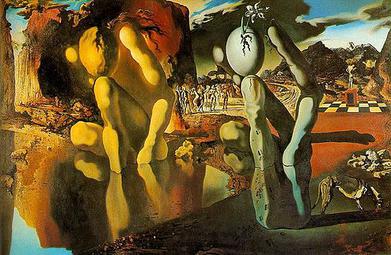
“Metamorphosis of Narcissus” painted by Salvador Dalí, 1937
A Central Figure in the Surrealist Movement
Salvador Dalí became one of the most celebrated figures in the Surrealist movement of the 1920s and 1930s. Surrealism was born out of a desire to explore the unconscious mind, often inspired by Sigmund Freud’s theories on dreams and the unconscious. Dalí embraced this wholeheartedly, using a method he called the “paranoiac-critical method”—a process where he would enter a self-induced state of paranoia to tap into irrational and subconscious imagery.
This method produced some of his most iconic works, such as:
• The Persistence of Memory (1931) – with its iconic melting clocks, symbolizing the fluidity and unreliability of time.
• The Elephants (1948) – featuring elongated, spindly-legged creatures that evoke both fragility and power.
• Dream Caused by the Flight of a Bee (1944) – combining hyperrealism with dreamlike symbolism.
These paintings highlight Salvador Dalí’s ability to create hyper-detailed, realistic imagery while presenting subjects that defied logic.

“The Persistence of Memory” painted by Salvador Dalí, 1931
Symbolism in Salvador Dalí’s Art
One of Salvador Dalí’s lasting contributions to art is his use of deeply personal and symbolic imagery. His paintings are filled with recurring motifs, each carrying layers of meaning:
• Melting clocks – a meditation on the relativity of time and memory.
• Ants and insects – representing decay and mortality.
• Crutches – symbols of support for the frailty of human existence.
• Eggs – representing hope, birth, and the future.
This personal lexicon of symbols created a world uniquely his own, making every painting a puzzle for collectors and art lovers to interpret.
Beyond the Canvas
Salvador Dalí’s genius wasn’t limited to traditional painting. He explored multiple mediums and disciplines, making him one of the most versatile artists of the 20th century:
• Sculpture – Dalí created surreal bronze sculptures that continue to attract collectors worldwide.
• Film – He collaborated with Alfred Hitchcock (on Spellbound) and Walt Disney (on the short film Destino).
• Fashion and Jewelry – Dalí designed surrealist jewelry, costumes, and even influenced haute couture.
• Architecture – His dreamlike concepts influenced public spaces, such as the Dalí Theatre-Museum in Figueres, which he personally designed.
This boundary-pushing creativity expanded his reach, showing that Surrealism could live not just in galleries but in everyday life.
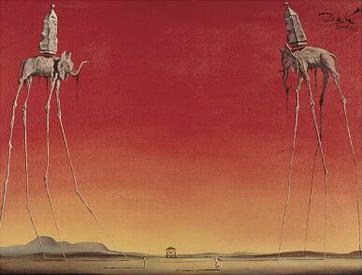
“The Elephants” painted by Salvador Dalí, 1948
Why Salvador Dalí Resonates with Collectors
Collectors prize Salvador Dalí’s work not only for its visual brilliance but also for its story. His paintings are conversation starters, gateways into dream analysis, and reflections of human psychology. Dalí’s art invites you to explore the subconscious, making each piece deeply personal to the viewer.
Moreover, owning a Salvador Dalí—whether an original, a limited print, or even a sculpture—is like owning a fragment of 20th-century cultural history. His works embody both artistry and theater, and that duality continues to intrigue serious art investors.
An Enduring Legacy
Today, Salvador Dalí remains one of the most famous artists in the world. His works are displayed in prestigious museums, including the Museo Nacional Centro de Arte Reina Sofía in Madrid and the Salvador Dalí Museum in St. Petersburg, Florida. His art continues to influence filmmakers, designers, and contemporary artists.
The genius of Salvador Dalí lies not only in his technical skill but in his audacity to live art as an extension of himself. His madness was his method, and his method was his brilliance.
Timeless Genius
Salvador Dalí was more than just a painter—he was a living embodiment of Surrealism. His ability to merge meticulous technical mastery with the bizarre and dreamlike made his works timeless. To collectors, Salvador Dalí represents both risk and reward: a man who dared to venture into the subconscious and bring back treasures for the world to see.
For anyone exploring art collecting, Salvador Dalí’s work stands as a reminder that true genius often lives where convention dares not go. His creations are not just paintings or sculptures—they are windows into the mysterious and the magnificent.
Attributions:
Salvador Dalí portrait, 1939, from the Carl Van Vechten photograph collection. Library of Congress LOT 12735, no. 275, LC-USZ62-116608
“Metamorphosis of Narcissus” by Salvador Dalí – http://www.kyushu-ns.ac.jp/~allan/Documents/societyincinema-03.htm, Fair use, https://en.wikipedia.org/w/index.php?curid=3729139
“The Persistence of Memory” by Salvador Dalí (1904-1989) – Image taken from About.com, Fair use, https://en.wikipedia.org/w/index.php?curid=20132344
“The Elephants” by Salvador Dalí –http://www.kloegartstore.nl/shop/images/Poster_26312.jpg, Fair use, https://en.wikipedia.org/w/index.php?curid=30732882